
Available as a configurable white-label platform

Run commerce, fulfilment and last‑mile delivery from one platform.

Launch a configurable digital-commerce operation connecting customers, merchants, inventory, payments, delivery teams and administrators across web and mobile experiences.

Codefremics provides the technology. Payment, tax, delivery and sector obligations stay with you and your authorised partners.

platform modules, from storefront to control centre
9
role experiences, from customer to dispatcher
5
stages on one shared order timeline
6
assistance across catalogue, dispatch and support, with people approving material outcomes
AI
Why operators move

Replace the spreadsheets between your systems.

Commerce, merchant, payment and delivery work usually runs on separate systems joined by manual hand-offs. One platform turns those hand-offs into a single controlled order lifecycle.

  1. TodayCommerce, merchant, payment and delivery operations are split across systems and spreadsheets.

    On one platformOne controlled order lifecycle, from discovery through fulfilment and after-sales service.

  2. TodayNobody has a reliable view of order state, inventory, settlement and delivery performance.

    On one platformA shared view of every order, stock position, settlement and delivery, with agreed metric definitions.

  3. TodayManual dispatch and reconciliation add cost and operational errors.

    On one platformRules-based dispatch, exception queues and reconciled payment, commission, merchant and rider records.

  4. TodayMerchants struggle to onboard catalogues, manage availability and understand their earnings.

    On one platformGuided onboarding, catalogue governance and clear settlement statements for every merchant.

  5. TodayEach new market needs its own payment, address, language, tax and delivery setup.

    On one platformLocal rules configured on one reusable platform, market by market.

Why one operating platform

Most commerce stacks end at checkout.

Storefront suites sell. Marketplace suites onboard sellers. Delivery platforms dispatch riders. Operators in emerging and multi-market environments need all three—with mobile money, cash on delivery and settlement—on one order record.

A comparison of common approaches, not of any named product. Capability status and integrations are confirmed for each engagement.
What the operation needsCodefremics Commerce & DeliveryCommerce suitesMarketplace and order-management suitesDelivery-management platforms
Storefront, catalogue and checkoutCommerce coreCoreVariesLimited
Multi-merchant onboarding, commissions and payoutsMarketplace & merchantsVariesCoreLimited
Order orchestration and multi-location inventoryOrchestration and inventoryVariesCoreLimited
Dispatch, riders, tracking and proof of deliveryDelivery & fleet managementLimitedLimitedCore
Merchant, rider and platform settlement on one ledgerSettlement and reconciliationLimitedVariesLimited
Cash on delivery collected, reconciled and settledDelivery and payments modulesLimitedLimitedVaries
Platform architecture

Nine modules. Six stages. One shared order truth.

Operate the full order lifecycle, not just a storefront. Each module is configured for your channels, merchants, fulfilment model and markets.

  1. 01DiscoverCustomer search, catalogue and availability.
  2. 02OrderCart, checkout, payment and confirmation.
  3. 03AcceptMerchant validation and preparation.
  4. 04FulfilPick, pack, split, substitute and hand off.
  5. 05DeliverDispatch, track, prove and handle exceptions.
  6. 06SettleReconcile payments, fees, merchants and riders.
Stages 01–02

Sell

  1. 01Commerce core

    Responsive storefront and customer account · Catalogue, search, cart, promotions and checkout · Order history, returns and notifications

  2. 02Marketplace & merchants

    Merchant onboarding, branches and roles · Catalogue governance, commissions and availability · Statements, settlements, disputes and performance

  3. 08B2B & wholesale commerce

    Business accounts, buyers and approval roles · Price lists, pack sizes, quotations and purchase orders · Bulk orders, invoices, statements and ERP integration
Stages 03–05

Fulfil and deliver

  1. 03Order orchestration & fulfilment

    Audited order-state model and stock reservation · Split, route, pick, pack and substitution workflows · Pickup, delivery, cancellation and refund cases

  2. 04Delivery & fleet management

    Rider, vehicle, shift, zone and service-level setup · Dispatch, batching, route and ETA recommendations · Proof of delivery, incidents, returns and earnings

  3. 06Inventory & warehousing

    Multi-location stock and reservation states · Receipts, transfers, counts, picking and restocking · Thresholds, overselling controls and audit history

Stage 06 and after-sales

Settle, serve and control

  1. 05Payments, settlement & reconciliation

    Verified payment and cash-on-delivery methods · Callbacks, idempotency, retries, reversals and refunds · Merchant, rider and platform allocation and audit

  2. 07Customer engagement & service

    Consent-aware multichannel notifications · Loyalty, referrals, reviews and service recovery · Shared timeline and support integrations

  3. 09Operational control centre

    Commerce, merchant and fulfilment performance · Delivery, payment and inventory exceptions · Permission-aware dashboards and metric definitions

Configured for distinct fulfilment realities

  • Grocery & supermarketWeighted items, substitutions, freshness and delivery windows
  • Restaurant & food deliveryMenus, modifiers, preparation times and batching
  • Pharmacy & healthcare productsControlled products and delivery verification, where legally designed
  • Retail & marketplaceVariants, multi-merchant catalogues, returns and commissions
  • Agriculture & distributionBulk quantities, collection points and quality records
  • Courier & parcelPickup pricing, tracking, proof and cash collection
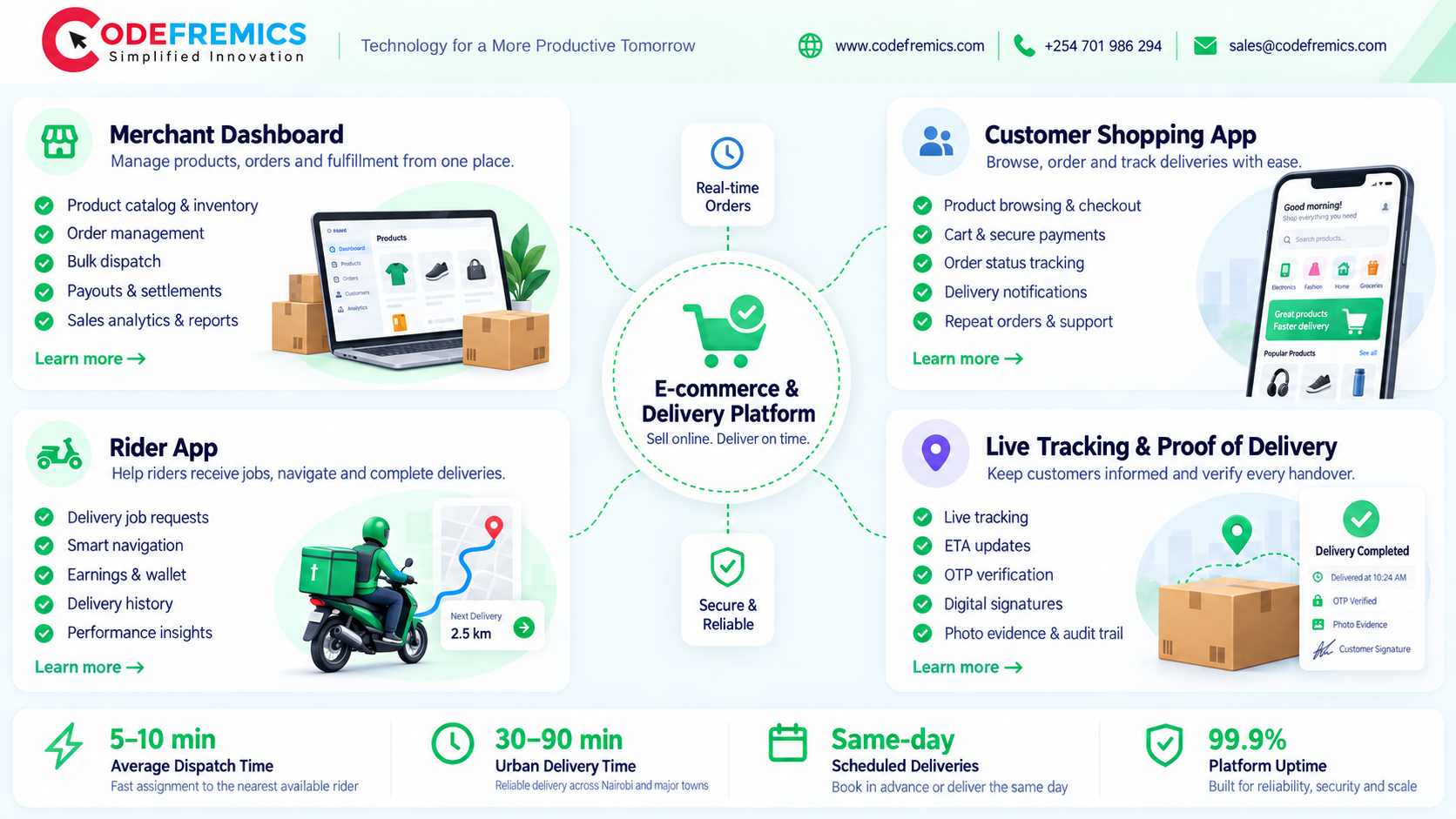
E-commerce and delivery platform overview
Platform order timelineOne order, every participant
  • CustomerOrders, pays and tracks
  • MerchantAccepts, prepares and substitutes
  • DispatcherAssigns, batches and handles exceptions
  • RiderPicks up and proves delivery
  • FinanceSettles merchant, rider and platform
Commerce + Delivery edition

Coordinate customer demand and last‑mile execution in one timeline.

Connect order promises with merchant preparation, inventory, dispatch capacity, delivery evidence, customer communication and financial reconciliation.

  • Manual dispatch, configurable rules and evaluated optimisation
  • Single, batched, multi-stop, pickup, return and transfer jobs
  • GPS events, ETA, PIN, signature, photo or barcode proof
  • Failed-delivery, reschedule, return-to-origin and dispute workflows
  • Own-fleet and verified third-party carrier integration models
Discuss your commerce operating model
Practical AI and automation

Automate the order flow. Keep people on material decisions.

Automation handles catalogue preparation, forecasting, assignment, routing and anomaly signals. Authorised people own the pricing, merchant, rider and refund decisions your customers and partners hold you to.

Automation handles

  • Catalogue categorisation and drafting
  • Grounded shopping assistance
  • Demand and capacity forecasting
  • Assignment, batching and routes
  • ETA estimates
  • Anomaly signals
  • Support copilot

Authorised people decide

  • Pricing changes
  • Merchant suspension
  • Refund outcomes
  • Rider sanctions

Suggestions carry their source and confidence, and material outcomes need human approval, so automation can scale without losing accountability.

Customer relevance

Ground conversational shopping, recommendations, bundles and substitutions in approved catalogue and availability data.

Operational assistance

Forecast volume and capacity, recommend routes or assignments and flag delivery, inventory or payment anomalies.

Control boundaries

Expose confidence and sources, require human approval for material outcomes and evaluate accuracy, latency, bias and benefit.

Governance and enterprise readiness

Built to stand up to board, finance and operations scrutiny.

The questions leadership asks before committing to a commerce platform—and how the platform is designed to answer them.

Who owns payments, tax and delivery?

Your organisation and its authorised partners. Codefremics supplies configurable technology and does not act as a payment, tax or delivery provider.

Can it run across markets and brands?

Countries, currencies, languages, time zones, brands, merchants, branches, warehouses and service zones are configured where supported.

How does it connect to our estate?

Through versioned APIs and webhooks with verified payment, mobile-money, mapping, messaging, POS, ERP, warehouse and carrier services.

How is it secured and audited?

Role-based access, single sign-on and multi-factor authentication where available, encryption, audit trails and an agreed support model.

What will management see?

Commerce, merchant, delivery, payment and inventory performance and exceptions, in permission-aware dashboards with agreed metric definitions.

How do we start without a big-bang programme?

Launch Commerce Core in one market, then add marketplace, delivery and enterprise capability on the same platform.

Codefremics provides

  • Configurable technology and implementation services
  • Workflow, integration, data and operational controls
  • Deployment, support and change services as contracted

Your organisation owns

  • Payment, tax and invoicing obligations
  • Merchant, rider and labour arrangements
  • Delivery, healthcare and other sector-specific compliance

Codefremics supplies configurable technology. Payment, tax, healthcare, labour, logistics and other regulated responsibilities remain with the authorised customer and partners in each market. Named providers and performance claims require verification. Review how we work in the Trust Center.

Editions

Launch focused. Expand on one platform.

Start with Commerce Core, then add merchants, delivery and enterprise capability. Warehousing, B2B, loyalty, AI and managed operations can be added. Scope and commercial terms are agreed during discovery.

  1. Entry point

    Commerce Core

    For one retailer or brand

    Storefront, catalogue, cart, checkout, order management, payment integrations, customer notifications and administration.

  2. Adds merchants

    Marketplace

    For marketplace operators

    Adds multi-merchant onboarding, storefronts, catalogue governance, commissions, disputes, settlements and merchant analytics.

  3. Lead configuration

    Commerce + Delivery

    For operators running their own last mile

    Adds rider and driver apps, dispatch, zones, assignment, tracking, proof of delivery, exceptions, earnings and cash reconciliation.

  4. Adds scale

    Enterprise

    For multi-market groups and brands

    Adds multi-market and brand configuration, advanced permissions, single sign-on, integration programme, deployment options and support.

Common questions

Choose a focused launch scope.

Share your channels, merchant model and delivery network, and we will confirm fit, scope and integrations during discovery.

Ask the product team a question
Can we launch under our own brand?

Yes. Branding, market structure, customer channels, merchant experiences and administrative roles can be configured as part of a white-label implementation.

Can we use our own delivery fleet and external carriers?

The operating model can support owned fleet workflows and verified third-party carrier integrations. Assignment, status, evidence, reconciliation and support ownership are defined per connector.

Does it support both B2C and B2B commerce?

Yes. The platform can combine consumer commerce with business accounts, negotiated catalogues, approvals, quotations, purchase orders and bulk fulfilment where included in scope.

Which payment providers are supported?

Integration patterns cover common payment categories, but named providers, currencies and countries are published only after verification for the target implementation.

Design your commerce operation

See your operation running end to end.

Share your markets, channels, merchant model, delivery network, payment landscape and launch priorities. We will tailor the demonstration around the workflows that matter.

How evaluation works

  1. 01Role-based demonstrationCustomer, merchant, rider, dispatcher and administrator journeys with your operating model.
  2. 02Architecture and integration reviewPayment, mapping, messaging, ERP and carrier connections, security and the responsibility model.
  3. 03Scoped launch planEdition, markets, fulfilment model and a phased release path.
WhatsApp us